More than 2,000 years ago, a ship sank somewhere in the Mediterranean.
For centuries, nobody knew what was resting beneath the water.
The ship carried statues, glassware, jewelry and other valuable objects. But among the wreckage was something much stranger.
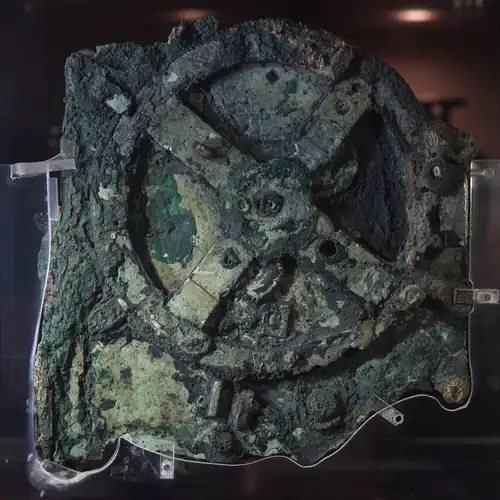
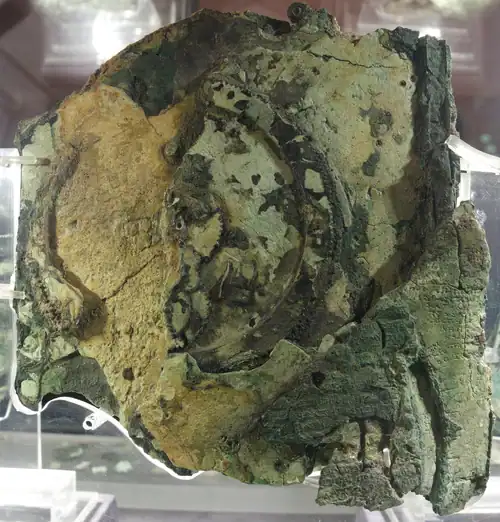
A collection of corroded bronze fragments.
At first glance, they looked like little more than pieces of an ancient object destroyed by the sea.
They weren’t.
Inside those fragments was a complicated system of gears that could track movements in the sky, follow lunar cycles and predict astronomical events.
Today, the device is known as the Antikythera Mechanism, and it is often described as the world’s oldest known analogue computer.
And perhaps the strangest part of the story is where it was found.
The wreck was discovered near a small Greek island called Antikythera.
The Discovery Beneath the Mediterranean
The story begins in 1900, when Greek sponge divers searching the waters around Antikythera came across the remains of an ancient ship.
The conditions were difficult. The wreck was sitting deep beneath the surface, near the rocky Greek coastline, and recovering objects from it was extremely challenging.
But the divers began bringing treasures back to the surface.
Ancient statues.
Ceramics.
Glass objects.
Coins.
Other pieces of cargo.
Among the discoveries were several strange bronze fragments that did not immediately reveal what they were.
They had been damaged by more than two thousand years beneath the sea.
Corrosion had transformed much of the metal, making the fragments difficult to understand.
Nobody looking at them on the surface would have guessed that they contained one of the most remarkable technological discoveries ever associated with the ancient world.
Then Scientists Looked Inside
The real mystery began when researchers started examining the fragments more carefully.
The bronze pieces contained gears.
Not one or two simple gears, but an intricate arrangement of interlocking wheels.
The discovery was extraordinary because complex geared technology of this sophistication was not expected from an object dating to the ancient Greek world.
Modern imaging techniques eventually allowed researchers to see details hidden inside the corroded fragments.
X-ray examinations and later three-dimensional imaging revealed gear trains, inscriptions and complicated mechanisms that had been invisible from the outside.
What had looked like a collection of broken bronze pieces was actually part of a sophisticated astronomical instrument.
The surviving mechanism contains around 30 bronze gear wheels and is divided into 82 surviving fragments.
Only part of the original device remains.
And that has made the mystery even harder to solve.
So What Did This Ancient “Computer” Do?
It wasn’t a computer in the modern electronic sense.
There was no electricity, processor or screen.
Instead, it was a mechanical calculating machine.
The user could operate the mechanism using a hand-driven system, causing the gears to move in carefully calculated relationships.
Those movements represented astronomical cycles.
The mechanism could model the movement of the Sun and Moon and was designed to predict eclipses. Researchers have also found evidence that it represented the movements of planets known to ancient Greek astronomers.
It also incorporated different calendar systems and the cycle associated with the ancient Olympic Games.
Think about what that means.
Someone in the ancient Mediterranean world could turn a mechanism made from bronze gears and use it to represent complicated movements taking place in the heavens.
The device transformed mathematical and astronomical knowledge into physical movement.
In other words, it didn’t simply tell someone that an eclipse was going to happen.
It mechanically represented the astronomical cycles that allowed such predictions to be made.
That is why researchers have compared it to an ancient analogue computer.
The Ancient Greek Connection
The mechanism wasn’t simply found near Greece.
Its design reflects the astronomical knowledge of the ancient Greek world.
Inscriptions discovered on the mechanism provide important clues about its purpose and operation.
Some of the surviving writing appears to explain astronomical cycles and how the device represented them.
Researchers have connected the mechanism with Greek mathematical astronomy, while also identifying influences from Babylonian astronomical traditions.
This is one of the reasons the discovery is so important.
It demonstrates that ancient scientific knowledge could be translated into an incredibly sophisticated mechanical device.
And yet, for centuries, the technology disappeared from history.
How Did Technology Like This Disappear?
This may be the most fascinating question of all.
The Antikythera Mechanism is not simply impressive because it is old.
It is impressive because comparable mechanical technology appears to be extremely rare in the surviving archaeological record for many centuries afterward.
Researchers have described the mechanism as more technically complex than any known device for at least a millennium afterward.
That creates an obvious mystery.
If ancient craftsmen could build something this complicated, what other technologies might have existed but simply disappeared?
And how much knowledge was lost when ancient workshops, libraries and scientific traditions disappeared?
We don’t have a complete answer.
The Antikythera Mechanism is a surviving piece of evidence from a much larger technological world that we can only partially reconstruct.
The Shipwreck Was Carrying More Than the Mechanism
The mechanism wasn’t the only extraordinary object found at the wreck.
The ship carried an astonishing collection of ancient objects, including sculptures, glassware, jewelry and other luxury goods.
One of the most famous discoveries was a statue of Hercules.
Other sculptures and objects recovered from the wreck show that this was no ordinary cargo shipment.
The ship appears to have been transporting valuable objects across the Mediterranean.
Exactly where it was heading and who owned all of its cargo remain subjects of archaeological investigation.
The mechanism may have been one of many valuable objects being transported.
But unlike a marble statue, its importance was hidden inside its construction.
Why Was It on a Ship?
This is another part of the mystery.
The mechanism appears to have been created in the ancient Greek world, but researchers continue to investigate exactly where it was made and how it ended up aboard the ship.
The vessel itself is generally associated with the late first century BCE, while the mechanism was constructed earlier.
That means the device may already have been an old and valuable scientific instrument when the ship sank.
Imagine finding a centuries-old scientific machine on a shipwreck today.
That is roughly the kind of historical puzzle archaeologists are dealing with.
Who owned it?
Who built it?
Why was it being transported?
Who was supposed to use it?
And what other similar machines once existed?
The surviving evidence cannot answer every question.
A Calendar Hidden Inside a Machine
One of the most remarkable features of the mechanism is its relationship with calendars.
Ancient societies depended heavily on accurate calendars.
They needed to track seasons, religious festivals, agricultural activities and astronomical events.
The Antikythera Mechanism brought several complicated cycles together through its gearing.
One of its dials represented the Metonic cycle, a period used to reconcile lunar months with the solar year.
Another mechanism was associated with predicting eclipses.
There was also a dial connected with the four-year cycle of the ancient Olympic Games and other Panhellenic competitions.
So this wasn’t simply a machine for looking at the stars.
It connected the movement of the heavens with the organization of human time.
The “Computer” Was Sitting at the Bottom of the Sea
For roughly two thousand years, the mechanism remained hidden underwater.
Its bronze gradually corroded.
Its wooden case disappeared.
Its components became separated and damaged.
Then Greek sponge divers brought pieces of it back to the surface.
Even after the discovery, scientists needed decades to understand what they were looking at.
Modern technology eventually changed the story.
X-ray imaging allowed researchers to see through the corrosion.
Inscriptions that could not be properly read before began providing clues about the machine.
Piece by piece, scientists started reconstructing the device.
And every new discovery made the original object seem more extraordinary.
You Can Still See It in Athens
Today, the surviving fragments of the Antikythera Mechanism are part of the collections of the National Archaeological Museum in Athens.
After spending thousands of years beneath the Mediterranean, the remains of the device can now be studied above the water.
They don’t look like a futuristic machine.
They are small, corroded and fragmented.
But behind those damaged pieces of bronze is evidence of an extraordinary ancient understanding of mathematics, astronomy and mechanical engineering.
That contrast may be what makes the mechanism so fascinating.
Something that looks almost insignificant can completely change our understanding of the past.
Greece’s Most Unexpected Technological Mystery
When people imagine ancient Greece, they often picture temples, marble statues and famous philosophers.
The Antikythera Mechanism adds something very different to that image.
It shows another side of the ancient Greek world.
A world of mathematical calculations, astronomical observation, mechanical engineering and attempts to physically reproduce the movements of the cosmos.
More than 2,000 years ago, someone built a machine from bronze gears that could turn astronomical knowledge into mechanical movement.
Then the machine disappeared beneath the Mediterranean.
For centuries, it remained there.
Until a group of Greek sponge divers happened to find the wreck.
And today, scientists are still trying to understand exactly how the machine worked.
The Antikythera Mechanism is not proof that ancient people had modern computers.
It is something more interesting.
It is proof that ancient engineers were capable of creating technology far more sophisticated than most people would expect.
And somewhere beneath the waters around Greece, there may still be pieces of the story we haven’t found yet.
Howdy! My name’s Tasos and I’m the face behind the blog. I’m a coffee-addicted adventurer from Greece that loves to write and show hidden places in Greece and also share tips and trick to make your journey here easier and smoother! <3