Call us at +306949885983

How to Rent a Car in Greece: 7 Mistakes Foreign Drivers Always Make

Renting a car in Greece sounds easy.
You land at Athens Airport, pick up the keys, throw your bags in the boot and suddenly the whole country is yours. You can leave the crowded tourist streets behind, find a quiet beach, stop at a mountain village for lunch and take a road that isn’t even on your original itinerary.
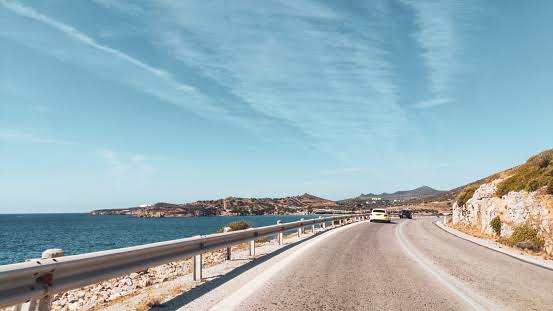
And that is exactly why renting a car in Greece can be such a wonderful idea.
But there is a catch.
Driving in Greece is not quite the same experience as driving in many other countries. The roads can change dramatically from modern highways to tiny mountain lanes within a few kilometres. Parking can be challenging, toll roads are common on major routes, and the small print on your rental agreement can matter much more than the attractive daily price you saw online.
Foreign visitors also sometimes arrive at the rental desk assuming that their normal driving licence, insurance and credit card will automatically be enough.
That can lead to an unpleasant surprise before the holiday has even started.
So, before you book that little Fiat, Toyota or Peugeot, here are seven mistakes foreign drivers should avoid when renting a car in Greece.
1. Assuming Every Foreign Driving Licence Is Automatically Accepted
This is probably the first thing you should check — before you pay for the rental.

The rules can depend on where your driving licence was issued and how it is written.
EU/EEA driving licences are generally accepted in Greece. The Greek government confirms that a valid driving licence issued by another EU member state remains valid in Greece under the applicable conditions.
For licences issued outside the EU/EEA, however, things can become more complicated.
Rental companies can have their own requirements. For example, Autohellas Hertz states that drivers must hold a licence for at least 12 months and that non-EU drivers require an international licence. SIXT’s Greece rental information similarly says that non-EU licences need to be accompanied by an international driving licence, while licences printed in a non-Roman alphabet require an International Driving Permit.
There is an important detail here:
An International Driving Permit does not replace your original driving licence.
You should carry the original licence with you.
SIXT specifically states that photocopies and digital licences are not accepted and that an IDP is valid only when presented together with the original licence.
The mistake
A traveller books a rental online, arrives in Greece with a digital copy of their licence or assumes their country’s licence will be sufficient, and only discovers the problem at the counter.
The smarter approach
Before booking, check the rental company’s specific requirements for:
- Your country of licence
- Your age
- How long you have held the licence
- Whether an IDP is required
- Whether the original physical licence is required
Do this before the holiday, not at the airport.
2. Choosing the Cheapest Car Without Reading What the Price Includes
That €18-a-day rental can look fantastic.
Until you reach the checkout page.
Then come the extras.
Airport charges. Additional drivers. Young-driver fees. Insurance upgrades. Child seats. One-way fees. Fuel charges. Ferry coverage. Administrative fees.
Suddenly your €18 car isn’t quite €18 anymore.
Rental prices in Greece vary enormously depending on the season, location, vehicle and booking conditions, so comparing the headline price alone can be misleading.
Even major rental companies have substantial differences between their basic coverage and optional protection.
For example, Autohellas Hertz states that its rentals include basic third-party liability insurance and certain vehicle protections, but customers can purchase additional coverages that reduce their financial responsibility for damage or theft. The company also lists specific exclusions, including damage to some parts of the vehicle such as tyres, wheels and the underside.
That last part matters in Greece.
A narrow road with a rough edge or an awkward parking manoeuvre can cause damage in places you might not normally think about.
The mistake
You compare cars based only on the daily rental price.
The smarter approach
Compare the total price, including:
Rental + insurance/excess + airport fees + additional driver + young-driver charges + fuel policy + any ferry requirements.
And read the exclusions.
A €10 saving isn’t much of a saving if you discover later that your particular damage isn’t covered.
3. Ignoring the Security Deposit
This one catches people all the time.
You have paid for your rental online.
You arrive at the counter.
Then the employee tells you that a substantial amount will be blocked on your card as a security deposit.
Suddenly you are wondering whether you have enough available credit.
A rental company’s security deposit is not necessarily an additional cost. In many cases it is a pre-authorisation that is released after the car is returned, provided there are no additional charges.
But you still need to have enough available funds on the card.
Autohellas Hertz, for example, states that a security deposit is pre-authorised or charged when the vehicle is collected. Its current terms say the amount can correspond to the excess applicable to the vehicle and coverage selected; with its Super Cover, the deposit can range from €100 to €500 depending on the vehicle category. The release can take up to 14 days depending on the bank.
Different companies and vehicle categories have different rules.
The mistake
You arrive with a card that has just enough available credit to cover the holiday.
The smarter approach
Before you travel, check:
- The deposit amount
- Whether the company accepts debit cards
- Whether a credit card is required for your vehicle category
- Whether the card must be in the main driver’s name
- How long the deposit may remain blocked
This is especially important for expensive or larger vehicles.
4. Treating Greek Roads Like the Roads Back Home
This is the mistake that can turn a beautiful Greek road trip into a stressful one.
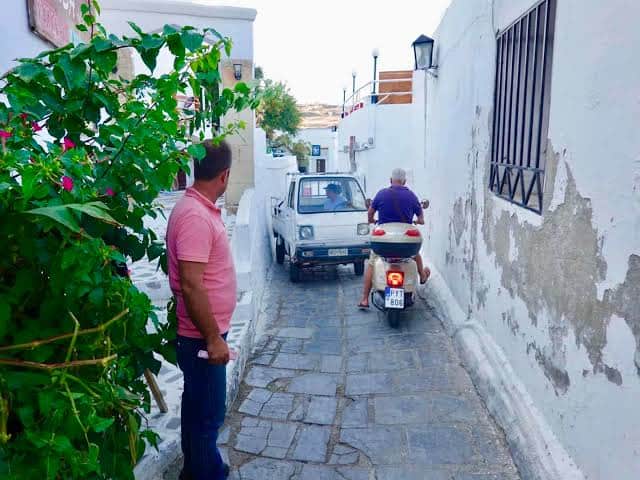
Greece has excellent modern roads in many areas.
It also has roads that are narrow, steep, winding, poorly lit or surprisingly busy.
And sometimes you can encounter all of those characteristics on the same journey.
On the mainland, major motorways can be straightforward and comfortable.
Then you turn towards a mountain village and suddenly you are driving through hairpin bends with a rock face on one side and a spectacular drop on the other.
On islands, roads can become particularly narrow. Some popular destinations have roads that were never designed for the number of rental cars they receive during July and August.
And then there is parking.
A space that looks perfectly acceptable when viewed from the driver’s seat may turn out to be much smaller than expected.
The mistake
Visitors rent the largest SUV they can afford because they assume bigger means better.
In many parts of Greece, the opposite can be true.
The smarter approach
Choose a car appropriate to your itinerary.
If you are spending your holiday driving around the Peloponnese, a larger vehicle might make sense for a family with luggage.
If you are exploring narrow island villages, a small car can be dramatically easier.
And don’t underestimate the importance of ground clearance if your itinerary involves remote roads — but always check what roads your rental agreement permits.
Most importantly, slow down.
You are on holiday.
You don’t need to drive a Greek mountain road as if you’re late for the airport.
5. Forgetting About Tolls
Greece is not a country where every major road is free.
If you are travelling long distances on the mainland, you will encounter toll stations.
The major motorway network includes toll roads, and payment can generally be made at toll stations using cash or cards, while some roads also support electronic transponders. Nea Odos, for example, lists payment by cash, credit/debit card and electronic transponder at its toll facilities.
For a tourist who has never driven in Greece, the toll system can initially seem confusing.
But there is nothing particularly difficult about it.
You approach the station, follow the lane appropriate to your payment method, pay the displayed amount and continue.
The mistake
You calculate your holiday driving budget using only:
car rental + petrol.
Then the motorway tolls appear.
The smarter approach
Before a long road trip, look at your route and estimate toll costs.
For example, if you are driving from Athens towards central or northern Greece, tolls can become a noticeable part of the overall journey cost.
The good news is that toll stations accept common payment methods on major routes.
Keep a card handy and, if you prefer cash, keep some euros in the car.
6. Taking the Rental Car on a Ferry Without Checking First
This is one of the most important Greece-specific mistakes.
You see the ferry.
You see the island.
You think:
“Of course I can take the rental car with me.”
Not necessarily.
Rental companies can have specific restrictions concerning ferry travel.
Autohellas Hertz, for example, requires prior written approval for ferry transportation and requires the renter to accept its Ferry Boat Cover. Without that approval and coverage, the renter can remain responsible for damage occurring during the ferry transfer regardless of other coverage purchased.
This matters enormously if you are planning a multi-island holiday.
Imagine renting a car in Athens, driving to Piraeus and putting it on a ferry to Paros, then continuing to Naxos and Santorini.
You cannot simply assume the rental agreement permits that itinerary.
The mistake
Booking the car without telling the rental company about your ferry plans.
The smarter approach
If you plan to take a rental car onto a ferry:
Ask the rental company before booking.
Confirm:
- Whether ferry travel is permitted
- Whether written approval is required
- Whether special insurance is required
- Whether there is an additional fee
- Whether there are restrictions on particular islands or routes
Sometimes the easiest solution is simply to rent another car after arriving on the island.
That can also save you the cost and hassle of transporting a car you don’t actually need.
7. Taking Photos of the Car — But Not Taking Enough
This may be the simplest piece of advice in the entire article.
Take photos.
Lots of them.
When you collect your rental car, walk around it before leaving.
Photograph:
- Every visible scratch
- Every dent
- Wheels and tyres
- Windscreen
- Mirrors
- Bumpers
- Roof
- Interior
- Dashboard
- Fuel level
- Mileage
And make sure the photographs are clear enough to show the condition of the vehicle.
If there is damage that isn’t recorded on the rental agreement, ask the employee to document it before you leave.
This takes five minutes.
It can save an argument later.
Rental companies also have procedures for accidents and damage. Autohellas Hertz, for example, instructs renters to complete an accident report and notes that failure to follow the required procedure can affect the validity of waiver products.
The mistake
You see a small scratch and think:
“They already know about it.”
Maybe they do.
Maybe they don’t.
The smarter approach
Document everything yourself.
The photos are your record of the vehicle’s condition when you received it.
So, Should You Rent a Car in Greece?
For many travellers, absolutely.
But don’t rent one simply because every travel website says you should.
If you are spending five days in central Athens, a rental car can actually be more trouble than it is worth.
Parking can be difficult, public transport can be convenient, and many major attractions are easier to reach without a car.
But if you’re planning a road trip through Crete, the Peloponnese, mainland Greece, Epirus, Halkidiki or another region where you want to explore beyond the main tourist centres, a car can completely change the experience.
You can stop at a roadside taverna because something smells incredible.
You can pull over for a view.
You can discover a tiny village that wasn’t on your itinerary.
You can spend the afternoon at a beach that isn’t next to a major resort.
That freedom is one of the best things about travelling around Greece.
Just make sure the freedom doesn’t begin with a surprise at the rental counter.
The Greek Car-Rental Checklist
Before you leave home, make sure you have checked:
✓ Driving licence — Confirm that your licence is accepted in Greece.
✓ International Driving Permit — Check whether your country and rental company require one.
✓ Original documents — Carry your physical driving licence and required identification.
✓ Age requirements — Minimum ages and young-driver charges vary by company and vehicle category.
✓ Credit/debit card — Check the company’s deposit and payment requirements.
✓ Insurance — Understand the excess, exclusions and optional coverage.
✓ Fuel policy — Know whether the car must be returned full, at the same level, or under another arrangement.
✓ Ferry permission — Never assume you can take the rental car onto a Greek ferry.
✓ Tolls — Budget for motorway tolls on mainland road trips.
✓ Vehicle inspection — Photograph the car before driving away.
✓ Emergency number and rental company’s assistance number — Keep them accessible.
And one final piece of advice from someone who loves Greece:
Don’t try to see everything.
Greece rewards slow travel.
Drive from Athens towards the Peloponnese and stop when you see something interesting. Take the longer road if you have time. Eat lunch in the village. Follow the coastline. Pull over safely and look at the sea.
The point of renting a car in Greece isn’t simply to get from one destination to another.
It’s to discover everything that happens between the destinations.
Just read the rental agreement first.
Then start the engine.
And enjoy the road.
Καλό δρόμο! 🇬🇷
About The Author
