Call us at +306949885983

Top 10 Archaeological Sites in Greece You Should Absolutely Visit (Including Knossos)

There is a reason Greece has long been regarded as the birthplace of the West. The land is home to an array of archaeological marvels, be it a Bronze Age palace or a Classical-era temple, and they have a way of wowing those who come to see them with a sense of history and enduring beauty.
For the armchair historian or anyone with a Greek holiday in mind, we’ve put together a list of the 10 top sites to see, the legendary Knossos in Crete among them.
🏛️ 1. Knossos (Crete)
- 📍 Location: Heraklion, Crete
- 🕰️ Era: Minoan Civilization (circa 1900–1400 BCE)
At the center of the enigmatic Minoan world lies Knossos, Europe’s most ancient palace. It is a place where history and the Minotaur myth are one and the same. The ruins here tell a story in stone and paint: you will find multi-level structures, some of the finest frescoes, and even plumbing that was far from primitive for its day.
What to see: make time for the Throne Room, the Grand Staircase and the well-known Dolphin Fresco.
🏺 2. Acropolis of Athens
- 📍 Location: Athens
- 🕰️ Era: 5th century BCE (Classical Period)
You won’t find a list of must-see places that doesn’t include the Acropolis. As an icon of the ancient world, it is defined by the Parthenon and was once the heart of Athens in both a religious and cultural sense.
A word to the wise: time your trip for the early hours or the evening light to get some good pictures without the hordes.
And while in the area, do not miss the Acropolis Museum for the statues and other pieces they have put on display from the hill above.
⚔️ 3. Delphi
- 📍 Location: Mount Parnassus, Central Greece
- 🕰️ Era: 8th century BCE to 4th century CE
In the heart of what was once the ancient world lies Delphi, where the Oracle of Apollo put out the kind of prophecies that made a mark on Greek history. One will find a theater, a stadium and the Temple of Apollo here, set against some fine mountain vistas. It is in the way the landscape plays off this heritage that Delphi has such a profound, spiritual pull.
🧱 4. Ancient Olympia
- 📍 Location: Peloponnese
- 🕰️ Era: 8th century BCE to 4th century CE
The site of the first Olympic Games, held in 776 BCE to pay homage to Zeus. Here one can putter around the remains of the old training grounds, some temples and the stadium itself.
A word to the wise: there is no harm in lacing up for a lap on the very track the ancients used. It is something to be had and not easily forgotten.
🏛️ 5. Epidaurus
- 📍 Location: Northeastern Peloponnese
- 🕰️ Era: 4th century BCE
There is the old theater, in fine condition and with room for 14,000; it is well known for the shows that are put on there even now. In its day, the place also served as a healing ground in honor of Asclepius. And then you have the acoustics: they are what you would call legendary, to the point where a murmur from up on stage carries to the very last row.
🏯 6. Mycenae
- 📍 Location: Argolis, Peloponnese
- 🕰️ Era: 1600–1100 BCE (Late Bronze Age)
Mycenae was a preeminent hub of Greek life in the time before the Classical period. The site is well known for such landmarks as the Lion Gate, the Tomb of Agamemnon and its so-called Cyclopean walls. There is an old story to be found in the Iliad and the Trojan War that runs through it.
The stonework is on another level; the blocks are of such a size that the ancients put it down to the handiwork of the Cyclopes.
🌊 7. Delos
- 📍 Location: Near Mykonos (Aegean Sea)
- 🕰️ Era: Flourished around 7th century BCE
There is a certain mystique to this little island. It is where the story of Apollo and Artemis begins. In its day, Delos was a centre for both trade and worship; today one can still see the fine remains of old mansions, the market, and the well-known Terrace of the Lions, among other temples.
You will have to put in from Mykonos by sea to get here. With no permanent residents on the island, a half-day is all it takes to make of it.
⚱️ 8. Vergina (Aigai)
- 📍 Location: Northern Greece, near Thessaloniki
- 🕰️ Era: 4th century BCE
Here lie the royal tombs of Philip II, Alexander the Great’s father. The subterranean museum puts on display the unbroken tomb and its contents: a collection of wondrous gold pieces and other relics that have withstood 2,300 years.
In many ways, this place has redefined our view of the Macedonian nobility. It is as striking as it is haunting.
🌆 9. Corinth
- 📍 Location: Peloponnese (near Athens)
- 🕰️ Era: Classical to Roman Periods
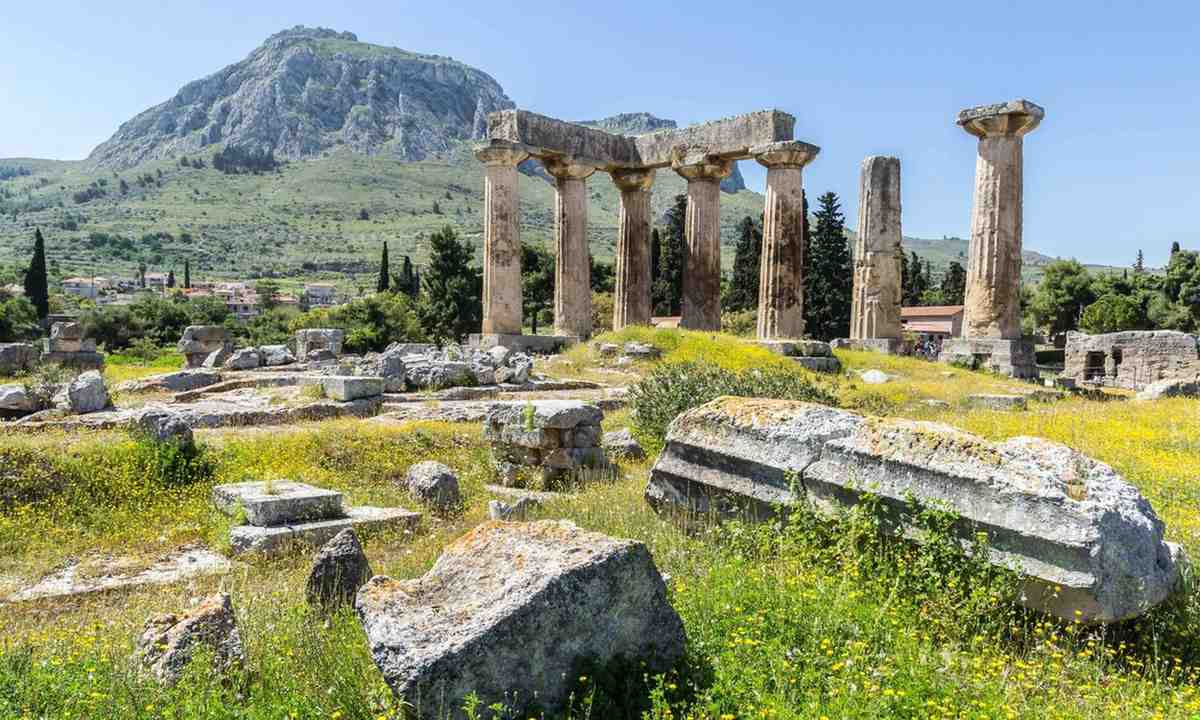
Ancient Corinth was once one of the most affluent city-states in all of Greece and a place of no small importance in Paul’s writings. The ruins here are home to such sights as the Temple of Apollo, the Roman Forum, and the Acrocorinth that looms over the city. It is a spot with both historical and spiritual weight for anyone with an eye on the early days of Christianity.
🔱 10. Dodona
- 📍 Location: Epirus, Northwestern Greece
- 🕰️ Era: Pre-Classical to Hellenistic Periods
You won’t find as many people at Dodona, but it is no less significant. In fact, it was the site of Greece’s most ancient oracle, predating even Delphi. At one time, the Oracle of Zeus made his will known from among the hallowed oaks, with priests making sense of the leaves in the wind.
It has an air of quiet mystery to it and is well worth a stop for those with an interest in history who like to get away from the usual tourist trail.
🗺️ Summary Table: Top 10 Archaeological Sites in Greece
| Site | Era | Key Highlight |
|---|---|---|
| Knossos | Minoan (1900–1400 BCE) | Mythical palace and frescoes |
| Acropolis | Classical (5th c. BCE) | Parthenon and hilltop views |
| Delphi | Archaic-Classical | Oracle and Temple of Apollo |
| Olympia | Archaic-Classical | First Olympic stadium |
| Epidaurus | Classical | Perfectly preserved theater |
| Mycenae | Bronze Age | Lion Gate and royal tombs |
| Delos | Archaic-Hellenistic | Birthplace of Apollo |
| Vergina | Macedonian | Tomb of Philip II |
| Corinth | Classical–Roman | Early Christian site |
| Dodona | Pre-Classical | Oldest Greek oracle |
A Few Words of Advice for the Archaeology Enthusiast
There is no better way to put some money back in your pocket than with a combo ticket for the Athens sites. When it comes to really getting to know a place, a licensed guide is worth the investment. For the more out-of-the-way locations, one can either put on a pair of wheels or sign up for a tour.
If the schedule allows, the months between April and June, or from September into October, are ideal; you will find the weather is more to your liking and the crowds have thinned out. And for a little extra direction, there are always free, app-based options like Rick Steves Audio Europe to lead the way.
Some Final Words
To see Greece as only a place for some sun and sand is to miss the point. It is, in many ways, a museum with a pulse. One can put on one’s walking shoes to retrace where Homeric kings once trod or to find what the old oracles had to say; every location has its own tale. Knossos holds the title of being the most venerable, but then again, all 10 of these places have their share of the unusual — be it an air of the unknown, a sense of history, or a way of connecting with times long past.
About The Author
