Call us at +306949885983
Tourists Are Traveling to This Greek Island to Swim With Pigs

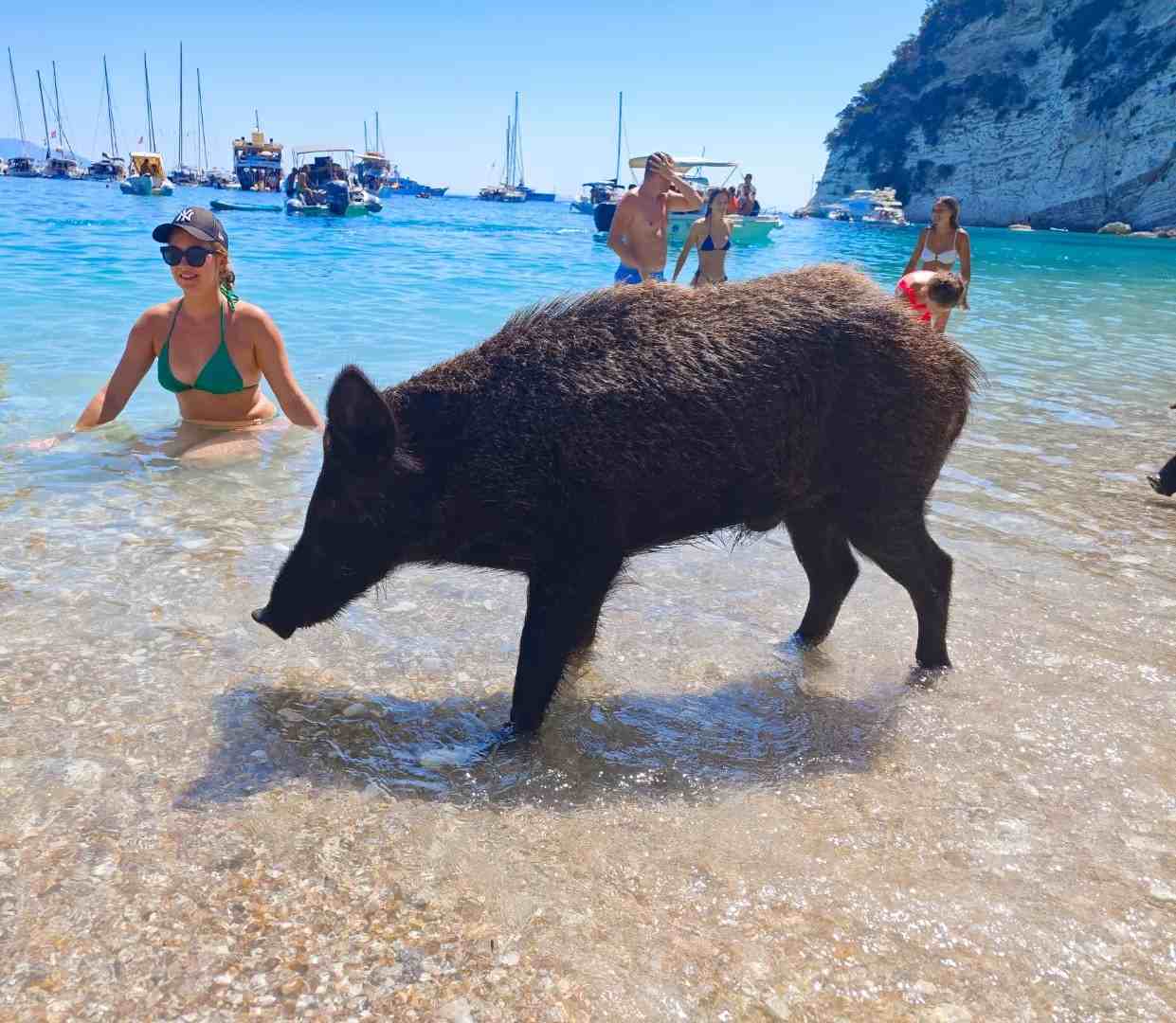
There is a tiny Greek island where you can arrive by boat, step onto a quiet beach, and find yourself surrounded by black pigs.
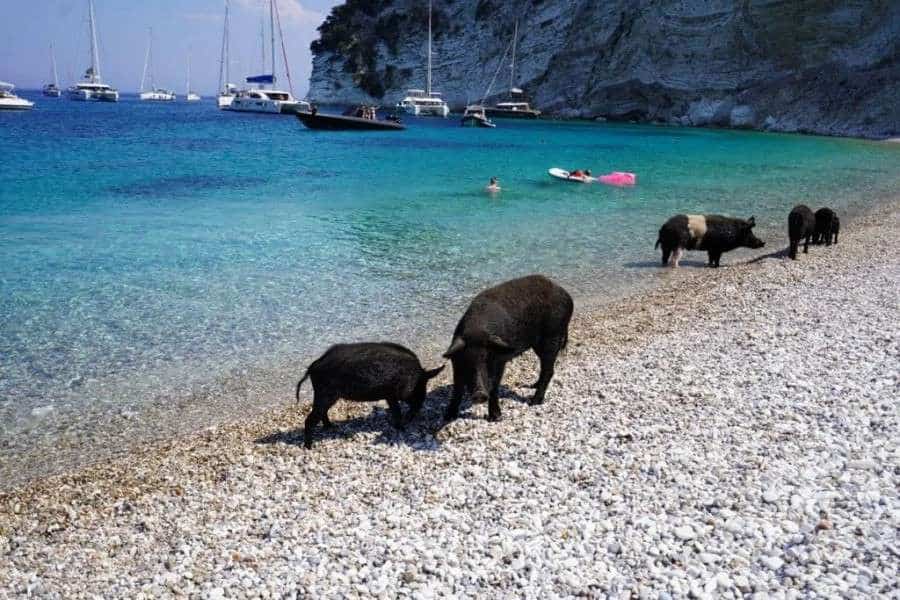
Some will be wandering across the sand.
Others may be looking for food near the boats.
And, if you’re lucky, you might even see one of them paddle into the Ionian Sea.
It sounds like something invented for social media.
It isn’t.
The island is called Atokos, and it has recently become one of the strangest new attractions in Greece.
Visitors are now deliberately taking boat trips to this otherwise little-known island because they want to meet its unusual residents. Some swim alongside them. Others sit on the beach and take photographs. Some even bring fruit to attract the animals closer to their boats.
And the strange story of how this tiny island became famous begins with a few viral videos.
The Greek Island Nobody Was Talking About
Atokos is a small, private and largely uninhabited island in the Ionian Sea.
It lies near Ithaca, with Lefkada and Kefalonia also relatively close by.
Unlike Greece’s famous holiday islands, Atokos doesn’t have the infrastructure most people associate with a tourist destination.
There are no large hotels.
There are no resort complexes.
There isn’t a busy town filled with restaurants and souvenir shops.
There isn’t even a conventional ferry terminal where thousands of tourists arrive every day.
Instead, visitors generally reach the island by boat.
For a long time, Atokos was known mainly to sailors, boaters and people exploring this part of the Ionian.
Then something unexpected happened.
The pigs went viral.
It Started With the Animals
Photos and videos began appearing on Instagram and TikTok showing black pigs wandering along the beach.
Then people noticed something even stranger.
The pigs weren’t simply living on the island.
They were going into the sea.
Videos showed the animals walking down toward the water, swimming near boats and cooling themselves off in the Ionian.
Some tourists were sitting on the beach while pigs wandered around them.
Others were getting into the water while the animals swam nearby.
The images were unusual enough to spread rapidly online.
Suddenly, Atokos had something that almost no other Greek island could offer.
A beach where your fellow swimmers might have four legs and a curly tail.
Recent reports say the island has now attracted visitors from around the world, with some tourists specifically asking boat operators to take them to Atokos to see the pigs.
Welcome to “Piggy Island”
Social media has given Atokos an unofficial new identity.
It is increasingly referred to as “Piggy Island.”
The nickname is playful, but it reflects just how much the animals have become part of the island’s appeal.
Boat excursions are now organized from nearby destinations, including Ithaca, Lefkada and Kefalonia.
One excursion operator told AFP that demand had increased sharply and that some travelers contact him specifically because they want to visit the pigs.
He reportedly makes several trips to the island during the day.
That is a remarkable transformation.
A place that was barely on the average tourist’s radar has suddenly become something people actively put on their holiday itinerary.
Not because of an ancient temple.
Not because of a luxury resort.
Not because of a famous nightlife scene.
Because of pigs.
And Yes, They Really Swim
This is the part that makes the story so strange.
The pigs don’t simply happen to be photographed near the shoreline.
They actually enter the water.
According to recent reports, the animals often go into the sea when temperatures rise, apparently using the water to cool themselves.
They can sometimes be seen paddling close to boats or moving through the shallows.
Underwater footage has even shown pigs swimming near visitors.
For tourists, this creates an experience that is difficult to replicate elsewhere.
You can be sitting on a Greek beach surrounded by the Ionian landscape, then suddenly notice a black pig walking toward the water.
A few moments later, it is swimming.
That combination is exactly what has made the island so popular online.
Why Are People Traveling There?
The answer is surprisingly simple.
People have seen the videos.
And they want to see it for themselves.
One recent visitor from Scotland described the encounter as an incredible and unique experience. Other tourists interviewed by AFP said they had discovered Atokos through Instagram and decided to visit while already holidaying in the region.
That is the modern travel phenomenon behind Atokos.
A place doesn’t necessarily need a famous monument anymore.
It needs something people want to share.
A photograph of a Greek beach is beautiful.
A photograph of a pig swimming toward a boat in that same Greek water is something people immediately want to send to somebody else.
And once that happens enough times, the destination can change almost overnight.
The Pigs Don’t Seem Particularly Impressed
Interestingly, the animals don’t appear to understand that they have become tourist celebrities.
They mostly go about their business.
They wander along the beach.
They search the sand for food.
They approach boats.
They swim when they want to cool down.
And they seem largely accustomed to people being around.
That doesn’t mean visitors should treat them like domesticated pets.
They are still animals living freely on an island.
Some visitors feed them fruit, and boat operators have reportedly used fruit to encourage the pigs to come closer to boats.
But getting too close or trying to handle an animal simply for a photograph is a different matter.
The best part of the experience may actually be watching them behave naturally rather than turning them into a petting attraction.
Where Did the Pigs Come From?
This is where the story gets even more interesting.
Nobody seems to have a completely satisfying modern explanation for how the pigs came to live on Atokos.
There are various local stories and theories surrounding them.
Some accounts suggest animals were left on the island in the past.
Other stories have circulated about how livestock may have reached the island.
But the recent reporting on the viral phenomenon doesn’t establish a definitive origin story.
And honestly, that makes the island more intriguing.
The pigs are there.
They have adapted to their surroundings.
They roam freely.
They swim.
And now thousands of people are traveling to see them.
But the exact story of how their population became established on this tiny private island remains less clear than you might expect.
This Isn’t Another Luxury Greek Resort
That’s perhaps what makes Atokos so fascinating.
Greece has spent decades building an international reputation around beautiful hotels, expensive villas, beach clubs, restaurants and luxury sailing experiences.
Atokos is almost the opposite.
There are no resorts waiting for you.
There isn’t a developed tourist village.
The island is largely uninhabited.
You don’t go there to spend a week in a hotel.
You go there as part of a boat trip.
You swim.
You explore the shoreline.
And you might encounter a group of pigs doing exactly the same thing.
The attraction is the experience itself.
A Different Kind of Greek Beach
Most people have a fairly predictable idea of what a Greek beach looks like.
Clear water.
A rocky coastline.
A small boat anchored offshore.
People swimming and sunbathing.
Maybe a beach bar somewhere nearby.
Atokos changes the picture.
Imagine arriving by boat and seeing a group of black pigs moving across the beach.
One walks toward the water.
Another follows.
Then suddenly they are swimming.
It’s such an unexpected scene that you might assume somebody had staged it for a photograph.
But recent images from the island show that this really is happening.
And that’s why Atokos has become so popular online.
Social Media Created a New Tourist Attraction
Atokos is also a perfect example of how dramatically social media has changed travel.
In the past, a destination usually needed years of promotion to become famous.
Tour operators, travel magazines and guidebooks would gradually introduce people to it.
Today, a few extraordinary videos can do the job.
Someone records a pig swimming beside a boat.
Someone else shares it.
Then another person sees it while scrolling through Instagram.
Within weeks, thousands of people know about a place they may never have heard of before.
That appears to be what happened with Atokos.
Recent reports describe the island as having gone from relatively unknown to attracting thousands of visitors, particularly during the summer season.
The pigs didn’t change.
The internet did.
But There Is a Bigger Question
There is something slightly ironic about the story.
People are traveling to a tiny, relatively undeveloped island because it offers something unusual and natural.
But the very popularity of the pigs could eventually change the experience.
More boats mean more visitors.
More visitors mean more interaction with the animals.
More interaction can mean more feeding, more noise and more pressure on a place that wasn’t designed as a major tourist attraction.
That doesn’t mean Atokos should be avoided.
It simply means that visitors need to remember what makes the place interesting in the first place.
It isn’t a theme park.
The pigs aren’t performers.
And the island isn’t a resort.
It’s a small natural environment that happened to become famous because its inhabitants behave in a way people find fascinating.
Should You Go Looking for the Pigs?
If you’re already exploring the Ionian islands by boat, Atokos is certainly one of the more unusual stops you can add to an itinerary.
But the experience isn’t necessarily about guaranteeing a photograph of a pig swimming directly beside you.
Animals are unpredictable.
They may be on the beach.
They may be somewhere else on the island.
They may enter the water.
Or they may decide they aren’t interested in visitors that day.
That’s part of what makes the encounter different from visiting a traditional attraction.
You aren’t watching an animal perform on a schedule.
You’re visiting its environment.
And if a pig decides to paddle into the Ionian while you’re there, you’ve simply been lucky enough to witness one of the strangest sights Greece currently has to offer.
The Most Unexpected Tourist Attraction in Greece?
There are thousands of islands, beaches and coastal locations around Greece.
Some are famous around the world.
Others remain almost completely unknown.
Atokos sits somewhere in between now.
Its name has suddenly started appearing in travel videos, boat excursions and social media posts because of an attraction nobody would have predicted.
Pigs.
Black pigs wandering across a Greek beach.
Pigs cooling themselves in the Ionian Sea.
Pigs approaching boats carrying tourists who have traveled specifically to see them.
It sounds like an internet joke.
But it is real.
And perhaps that’s why the story has spread so quickly.
Greece already has the beaches, islands and spectacular scenery that millions of people dream about.
Atokos simply added something nobody expected.
A swimming pig.
And now, people are getting on boats and crossing the Ionian Sea just to see it.
The tiny island that was once easy to overlook has become one of Greece’s strangest viral travel stories.
And if social media keeps doing what it has done so far, it may not stay a secret for very much longer.
About The Author
