Call us at +306949885983

Greece Wants Europe to Change Its Migration Rules. Here’s What the Proposal Means


Greece is calling for tougher emergency powers to deal with sudden mass arrivals of migrants. The proposal could reopen one of Europe’s most controversial debates: should countries be allowed to temporarily suspend asylum applications during an exceptional migration crisis?
For years, European governments have struggled with a question that refuses to disappear.
What happens when large numbers of people arrive at a country’s borders, the authorities struggle to process them, and the existing rules are no longer considered sufficient to manage the situation?
Greece believes Europe needs a stronger answer.
On October 1, Greek Migration and Asylum Minister Thanos Plevris presented a proposal at a meeting of EU interior ministers in Luxembourg. His proposal called for member states to be allowed to temporarily suspend asylum applications during major migration flows.
The idea is controversial. It could change how Europe responds to a sudden influx of migrants, but it also raises serious questions about asylum rights, international law and the limits of government power.
And Greece is not making this argument in isolation.
Other European governments are also pushing for tougher measures, while EU institutions are working on new ways to manage migration emergencies.
So what exactly does Greece want, why is it pushing for change now, and could this proposal become a reality?
The answers reveal a much bigger debate about Europe’s borders and its future.
What Exactly Is Greece Asking For?

The Greek proposal focuses on exceptional situations involving a sudden, large-scale arrival of migrants.
Under the approach proposed by Athens, EU member states would be able to temporarily suspend asylum applications in certain emergency circumstances.
In practical terms, this would represent a significant departure from the usual process.
Normally, a person who arrives in an EU country and requests international protection must have their claim handled under the applicable asylum rules. Authorities assess the circumstances of the individual case and determine whether the person qualifies for protection.
Greece argues that exceptional situations may require a different response.
Imagine a border experiencing an enormous, sudden increase in arrivals over a short period.
Border officials must register people, establish identities, assess security concerns and determine which legal procedures apply. Reception facilities and administrative resources can come under considerable pressure.
Now imagine that the authorities believe the arrivals are being deliberately encouraged or exploited by another country as a way to put pressure on the EU.
Should the government have additional emergency powers to respond?
That is the central question behind the Greek proposal.
Plevris has argued that Europe needs a legal mechanism that allows it to manage these situations as border emergencies rather than relying exclusively on the ordinary asylum process.
But there is an important distinction.
Greece has proposed this change. It has not received blanket permission to suspend asylum applications across the EU.
The proposal faces legal and political obstacles, and any future measure would need to be assessed against European and international obligations.
That distinction matters because the debate is only beginning.
Why Is Greece Pushing for This Now?
To understand the Greek position, it helps to look at the country’s geography.
Greece sits at the southeastern edge of the European Union. Its land border with Turkey and its extensive coastline place it along important routes used by people seeking to enter Europe.
The Aegean islands, the Evros border region and the sea routes around Crete have all featured in the country’s migration challenges.
Unlike countries located farther inside Europe, Greece can find itself dealing with arrivals at the EU’s external borders before other member states become directly involved.
This creates a difficult combination of responsibilities.
Greece must protect its borders, manage arrivals, process asylum claims where applicable and provide access to procedures required by law.
It must also cooperate with European partners while dealing with the practical demands placed on local authorities, services and reception facilities.
For Athens, the concern is not simply whether Europe can manage migration during ordinary periods.
It is whether the system can respond effectively when the number of arrivals rises suddenly.
The Greek government argues that the EU’s existing migration framework does not provide sufficient tools for every possible emergency.
That is why it wants additional powers.
The question is whether other European governments will agree that such powers are necessary, and whether a legally workable version of the proposal can be developed.
The Ceuta Crisis That Put the Debate Back in the Spotlight
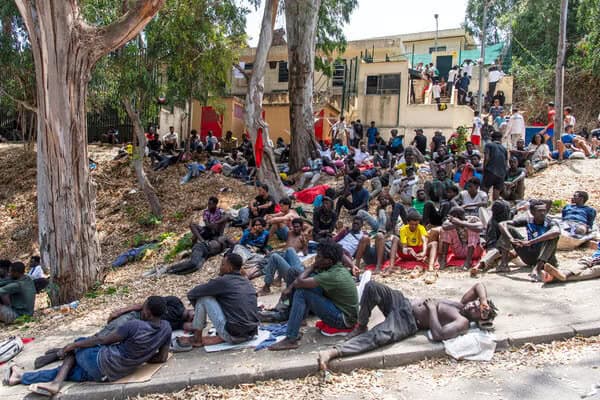
One of the immediate examples cited in the debate was Ceuta, the Spanish territory located on the North African coast.
In late July 2026, Spain reported a major influx of migrants into the territory.
According to figures reported at the time, more than 72,000 people entered Ceuta during the episode. Most subsequently returned, while approximately 10,000 remained.
The scale of the arrivals reignited questions about how a European country should respond when a border faces an extraordinary surge.
For governments seeking tougher rules, the episode illustrated a problem that goes beyond the number of people arriving.
It raised concerns about whether existing procedures can cope with sudden pressure and whether migration flows can be used to influence or destabilise a neighbouring country.
The Greek proposal is partly a response to that broader concern.
Supporters argue that European countries need emergency mechanisms before a crisis overwhelms their ability to respond.
Critics, however, warn that suspending asylum applications could leave people without an effective opportunity to present claims for protection.
These are competing concerns, and both are central to the debate.
The challenge for European policymakers is to determine what powers are necessary in a genuine emergency without abandoning the legal safeguards that govern asylum.
Could Europe Really Suspend the Right to Apply for Asylum?
This is where the story becomes more complicated.
The proposal is not simply a question of whether governments want tougher border controls.
It involves the relationship between national sovereignty, EU law and international obligations.
European countries have considerable authority over their borders. However, that authority operates within a legal framework that includes protections for people seeking international protection.
One of the most important principles is non-refoulement.
In simple terms, a country must not send someone to a place where they face the relevant risks of persecution, torture or other prohibited serious harm.
The details depend on the applicable legal framework, but the principle places limits on what governments can do when dealing with people seeking protection.
Asylum procedures also involve safeguards designed to ensure that claims are considered under the relevant rules.
A general suspension of asylum applications could therefore raise serious legal questions, particularly if it prevented people from accessing procedures or exposed them to removal without the required assessment.
That is why a political announcement cannot automatically become a functioning policy.
European governments would need to determine what circumstances could trigger an emergency measure, how long it could last, what safeguards would remain in place and how its application could be reviewed.
Consider the questions policymakers would have to answer:
- What qualifies as an emergency? A temporary increase in arrivals is not necessarily the same as an extraordinary crisis.
- Who decides when emergency powers begin? Would national governments act independently, or would an EU-level mechanism be required?
- How long could restrictions remain in place? Emergency powers without clear limits could create further legal problems.
- What happens to people who face genuine persecution? Any measure must address the relevant legal protections.
- Who checks whether the rules are being followed? Oversight and access to legal remedies would remain major issues.
These are not minor technicalities.
They could determine whether the Greek proposal becomes a workable European policy or remains a controversial political demand.
Is Europe Already Becoming Tougher on Migration?
Yes, there is a broader shift towards stronger enforcement, and the developments of October 1 demonstrate it.
On the same day Greece presented its proposal, the Council of the European Union adopted new rules designed to make the return of people without a legal right to remain in the EU more effective.
This is a separate measure from Greece’s proposed suspension of asylum applications.
The distinction is important.
The new return rules concern people who have been determined not to have a legal right to stay and are subject to a return decision. Greece’s proposal concerns whether asylum applications could be temporarily suspended in certain exceptional mass-arrival situations.
They address different stages of the migration process.
The new EU return framework introduces several measures intended to help national authorities enforce return decisions.
These include:
- A European Return Order: A common framework for recording key elements of return decisions and facilitating cooperation between member states.
- Stronger obligations to cooperate: People who have no right to stay must cooperate with authorities in the return process.
- Possible sanctions: Depending on the circumstances and national law, failure to cooperate can lead to measures such as financial penalties or other sanctions.
- Return hubs outside the EU: Member states can establish arrangements with non-EU countries to transfer eligible people who are subject to return decisions.
- Stricter measures in security cases: Additional measures may apply to people who pose a security risk, subject to the rules and safeguards.
These changes are significant because they focus on a longstanding weakness in European migration policy.
Issuing a decision requiring someone to leave is one thing.
Ensuring that the decision is actually carried out is another.
The EU has acknowledged that many people ordered to leave do not ultimately depart. The new framework is intended to improve cooperation and enforcement.
However, the rules do not eliminate the requirement to respect fundamental rights and applicable international law.
Nor do they mean that every person arriving irregularly can automatically be deported without an individual assessment where one is legally required.
Europe is tightening parts of its migration system, but the details still matter.
What Are Return Hubs, and Why Are They Controversial?
Return hubs are another development worth watching.
Under the new EU framework, member states can establish arrangements with non-EU countries to receive people who have no legal right to remain in the Union and are subject to return decisions.
Depending on the arrangement, these facilities could serve as destinations for return or as transfer centres supporting onward return.
The concept is intended to help European governments enforce decisions that are difficult to implement through existing arrangements with countries of origin.
But return hubs also raise difficult questions.
Where would they be located?
What would conditions be like?
Who would supervise the facilities, and what would happen if a person challenged their removal or faced a risk of serious harm?
The legal framework requires relevant arrangements to respect international human rights standards and the principle of non-refoulement. Unaccompanied minors are excluded from these arrangements.
Those requirements will be crucial in determining how the system operates in practice.
Greece is among a group of European countries exploring the possibility of establishing such facilities, alongside the Netherlands, Germany, Austria and Denmark.
The group has discussed identifying a host country and potentially beginning transfers in 2027.
The precise arrangements and implementation will matter far more than the headline alone.
For supporters, return hubs could provide a practical way to make return decisions more effective.
For critics, they risk shifting difficult questions about responsibility and human rights beyond the EU’s borders.
Either way, the policy could become an important part of Europe’s migration debate.
What Does All This Mean for Greece?
For Greece, these developments have particular significance.
The country is not only managing its own migration policy. It is also trying to influence how the European Union responds to pressure at its external borders.
Athens wants greater flexibility during exceptional surges, while the new EU return framework offers additional tools for enforcing decisions against people who have no legal right to remain.
Together, these developments suggest that European migration policy is moving towards a stronger emphasis on border management and enforcement.
But that does not mean every proposal will become law or that every new measure will work as intended.
Greece still needs cooperation from other EU governments, workable agreements with third countries and administrative capacity to implement the rules.
It must also operate within the legal obligations that apply to asylum and returns.
There is another practical consideration.
Migration routes change. Policies that affect one border may influence movements elsewhere. A measure that reduces arrivals in one location could lead to increased pressure on another route.
This makes coordination between European countries essential.
A national policy cannot solve a problem that operates across multiple borders on its own.
That is one reason Greece has pushed for a European response rather than treating the issue as exclusively a Greek responsibility.
The Bigger Question Europe Must Answer
The argument over Greece’s proposal reflects a much wider disagreement about the future of European migration policy.
One side argues that a country cannot maintain public confidence in its immigration system if it cannot effectively control its borders or enforce decisions made under its own laws.
From this perspective, emergency powers and more effective returns are necessary to maintain order and discourage dangerous journeys facilitated by smugglers.
The opposing concern is that extraordinary powers can weaken legal protections if they are too broad, poorly defined or applied without adequate oversight.
From this perspective, border security and the right to seek protection must be addressed together rather than treated as mutually exclusive.
The debate is not going to disappear.
European governments face pressure to demonstrate that migration rules are enforceable. At the same time, they must comply with the legal commitments that distinguish a rules-based system from arbitrary action.
The difficult question is how to achieve both objectives.
Can Europe build a system that responds quickly to genuine emergencies, processes claims fairly and carries out lawful return decisions effectively?
Or will disagreements between member states, legal challenges and practical obstacles continue to undermine the system?
The coming months should provide a clearer picture.
What Happens Next?
Greece’s proposal will require further political and legal consideration before it could become an operative EU mechanism.
For now, it should not be confused with an approved, general suspension of asylum applications.
The new EU return rules are a separate development, adopted on October 1, 2026, with implementation taking place according to the regulation’s provisions.
Meanwhile, European governments are continuing to discuss how to respond to sudden migration emergencies and how to improve cooperation on returns.
Three developments are worth watching:
- The European Commission’s emergency response framework. Will it provide a mechanism that addresses the concerns raised by Greece while respecting existing legal obligations?
- The practical implementation of the new return rules. Will European countries become more successful at carrying out lawful return decisions?
- The development of return hubs. Will member states reach agreements with host countries, and what safeguards will govern their operation?
These decisions could influence how Europe handles future migration crises.
They will also test whether EU governments can agree on a common approach when national interests and legal obligations come under pressure.
One thing is clear: Greece wants Europe to go further than it has gone so far.
Whether the rest of the EU is prepared to follow remains an open question.
What do you think? Should European countries have the power to temporarily suspend asylum applications during an exceptional mass-arrival emergency, or would that go too far?
The answer will shape one of Europe’s most consequential political debates for years to come.
About The Author
